5 Awesome Mage AI Alternatives
 Yulei Chen
Mage AI is an open-source data pipeline tool that makes it easy to build, run, and manage ETL/ELT workflows with a notebook-style visual editor. It supports dbt integrations, real-time streaming, and AI-assisted pipeline building out of the box. Mage's managed cloud (Mage Pro) starts at $100/month plus $0.29 per CPU-hour for pipeline runtime, which can add up quickly for larger workloads. If you want full control and predictable costs, you can self-host Mage AI on Sliplane for just €9/month per server.
But maybe Mage AI isn't quite the right fit for your use case. Maybe you need battle-tested production orchestration, asset-centric lineage tracking, or a declarative YAML approach. Let's look at 5 awesome alternatives!
1. Apache Airflow
Apache Airflow is the most widely adopted open-source workflow orchestration platform, originally built by Airbnb. With Airflow 3 (released in 2025), it gained asset-aware scheduling, DAG versioning, and multi-team deployments. Where Mage AI focuses on a notebook-style editing experience, Airflow gives you full programmatic control over complex DAG structures in Python.
- Features: Python-based DAG definitions, a rich web UI for monitoring and triggering runs, 2,000+ community-maintained operator plugins, asset-aware scheduling, dynamic task mapping, XCom for inter-task communication, and extensive integrations with AWS, GCP, Azure, databases, and more.
- Why You Should Use It: If you need an orchestrator with the largest ecosystem and community support, Airflow is the safe bet. Nearly every data tool has an Airflow operator or hook, and hiring Airflow-experienced engineers is easier than for any other orchestrator. It's the industry standard for a reason.
- Why Not: Airflow has a steep learning curve and requires significant operational overhead to run in production (metadata database, scheduler, workers, Redis/Celery). DAGs are code-only with no visual editor. It's not ideal for teams that want a low-code experience like Mage offers.
- Pricing: Apache Airflow is free and open-source. Managed hosting via Astronomer (Astro) starts at $0.35/hr per deployment (~$250/month minimum). AWS MWAA starts around $350/month, Google Cloud Composer around $300/month. Self-hosting typically costs $50-200/month for infrastructure.
2. Dagster
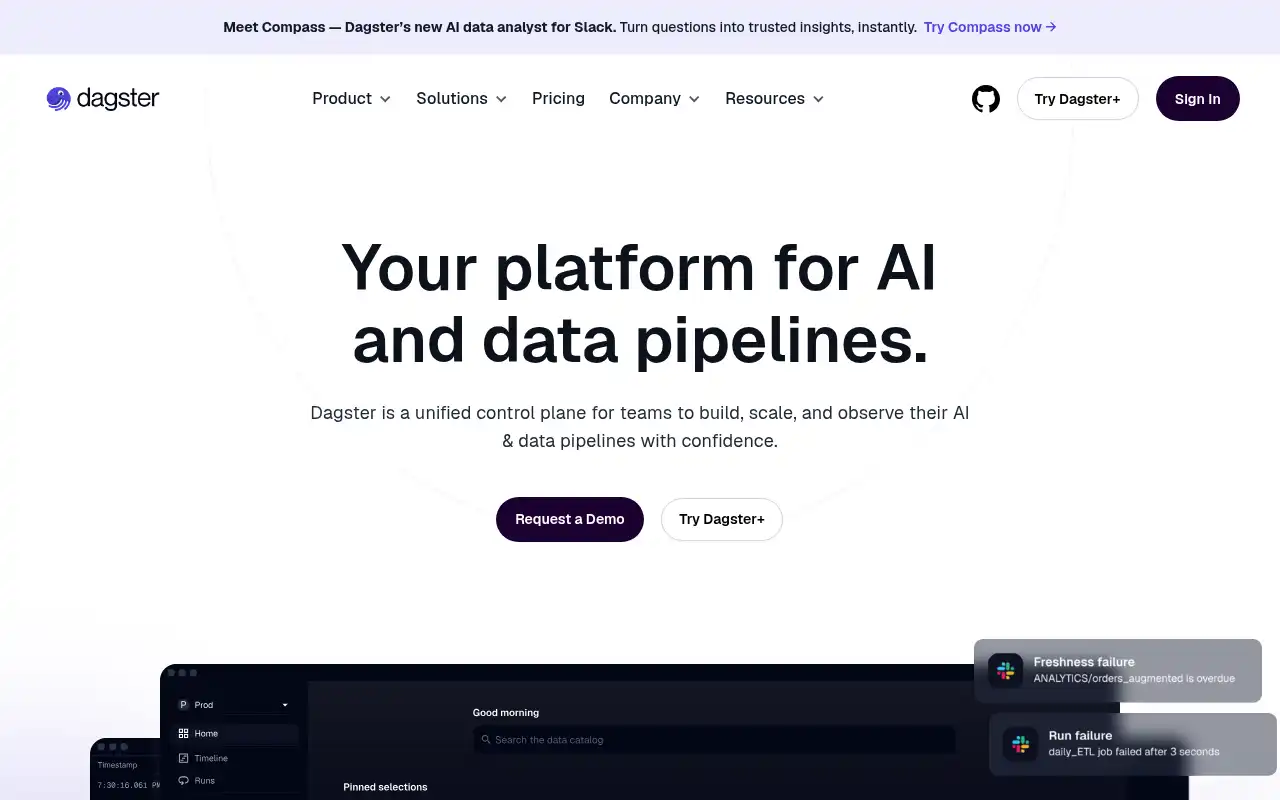
Dagster is a modern data orchestrator that takes an asset-centric approach, treating your data assets (tables, ML models, reports) as first-class citizens rather than focusing on tasks. It includes built-in data lineage, quality checks, and observability, making it a strong choice for analytics engineering teams.
- Features: Software-Defined Assets (SDAs), built-in data lineage and catalog, asset health monitoring, Dagster Components for reusable pipeline patterns, Compass AI assistant for Slack, partitioned assets, sensor-based triggers, dbt integration, and a polished local development experience.
- Why You Should Use It: If your team thinks in terms of data assets rather than tasks, Dagster is the best fit. The asset-centric model makes it natural to reason about what data exists, when it was last refreshed, and whether it's healthy. The local development experience is excellent, and the dbt integration is among the best of any orchestrator.
- Why Not: Dagster's asset-centric model has a learning curve if you're used to task-based orchestration. The community is smaller than Airflow's, so finding plugins and hiring experienced engineers is harder. Credit-based pricing in Dagster+ can be unpredictable for high-volume workloads.
- Pricing: Open-source is free. Dagster+ Solo starts at $10/month + $0.04/credit. Starter is $100/month + $0.035/credit. Serverless compute adds $0.01/minute. Enterprise pricing is custom. Free 30-day trial available.
3. Prefect
Prefect is a Python-native orchestration platform that prioritizes developer experience and dynamic workflows. Unlike Airflow's static DAG definitions, Prefect lets you write standard Python code with decorators and handles the orchestration behind the scenes. Its hybrid execution model runs your flows anywhere while managing state in Prefect Cloud.
- Features: Python-native workflow definitions with
@flowand@taskdecorators, dynamic and conditional workflows, hybrid execution model (run anywhere, observe everywhere), event-driven automations, built-in retries and caching, serverless compute option, a@materializeasset layer with asset checks, and a clean web UI. - Why You Should Use It: If you want the simplest Python-first experience with minimal boilerplate, Prefect is hard to beat. You can turn any Python function into an orchestrated workflow with a single decorator. The hybrid model means you keep your code and data on your own infrastructure while getting cloud-level observability. Pricing is seat-based, not usage-based, so costs are predictable.
- Why Not: Prefect's ecosystem of pre-built integrations is smaller than Airflow's. The asset layer is newer and less mature than Dagster's. The seat-based pricing can get expensive for large teams. Self-hosted Prefect Server lacks some cloud features like RBAC and SSO.
- Pricing: Open-source server is free. Hobby tier is free (2 users, 5 workflows). Team plan is $400/month (8 seats, serverless compute included). Enterprise pricing is custom. Serverless overages at $0.005/minute.
4. Kestra
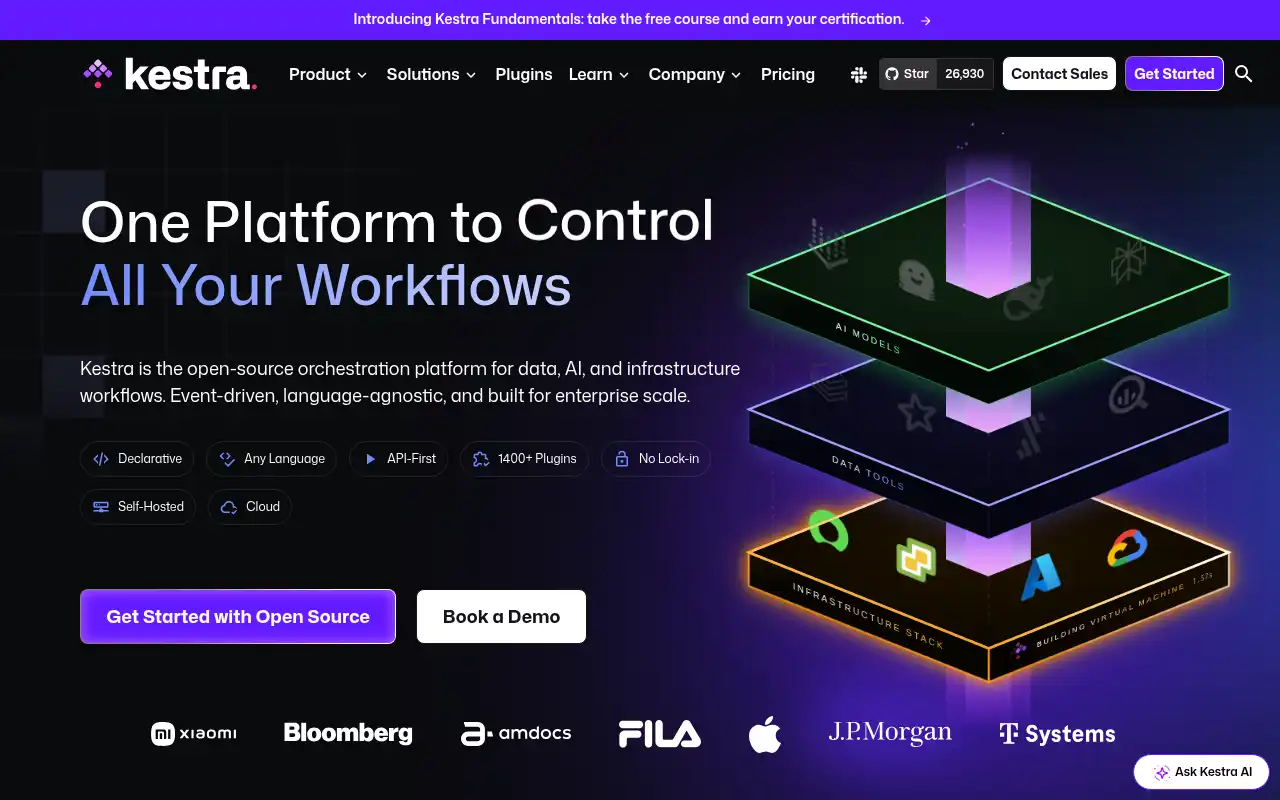
Kestra is a declarative, event-driven orchestration platform that uses YAML to define workflows instead of code. This makes it accessible to teams that include non-developers, and it offers a visual editor for building flows in the browser. With over 26,000 GitHub stars and $36M in funding, it's the fastest-growing open-source orchestrator.
- Features: Declarative YAML workflow definitions, visual flow editor in the browser, 600+ plugins for integrations, event-driven triggers, real-time processing, embedded code editor supporting Python/R/Node/Shell, namespace-based multi-tenancy, Git integration and versioning, and Kubernetes-native scaling.
- Why You Should Use It: If your team includes data analysts, DevOps engineers, or other non-Python developers, Kestra's YAML-based approach is much more accessible than code-first tools like Airflow or Prefect. The visual editor makes it easy to build and debug workflows without writing code. The plugin ecosystem is rich, and the event-driven architecture handles both batch and streaming use cases.
- Why Not: YAML-based definitions can become unwieldy for complex logic that's better expressed in code. If your team is Python-heavy, Kestra's approach may feel limiting compared to Prefect or Dagster. Cloud pricing isn't publicly listed, so budgeting requires a sales conversation.
- Pricing: Open-source is free. Enterprise (self-hosted) and Kestra Cloud (fully managed) both require contacting sales for pricing. The Enterprise edition uses an instance-based model with no per-user or per-workflow limits. Self-hosting the open-source version is free.
5. Bruin
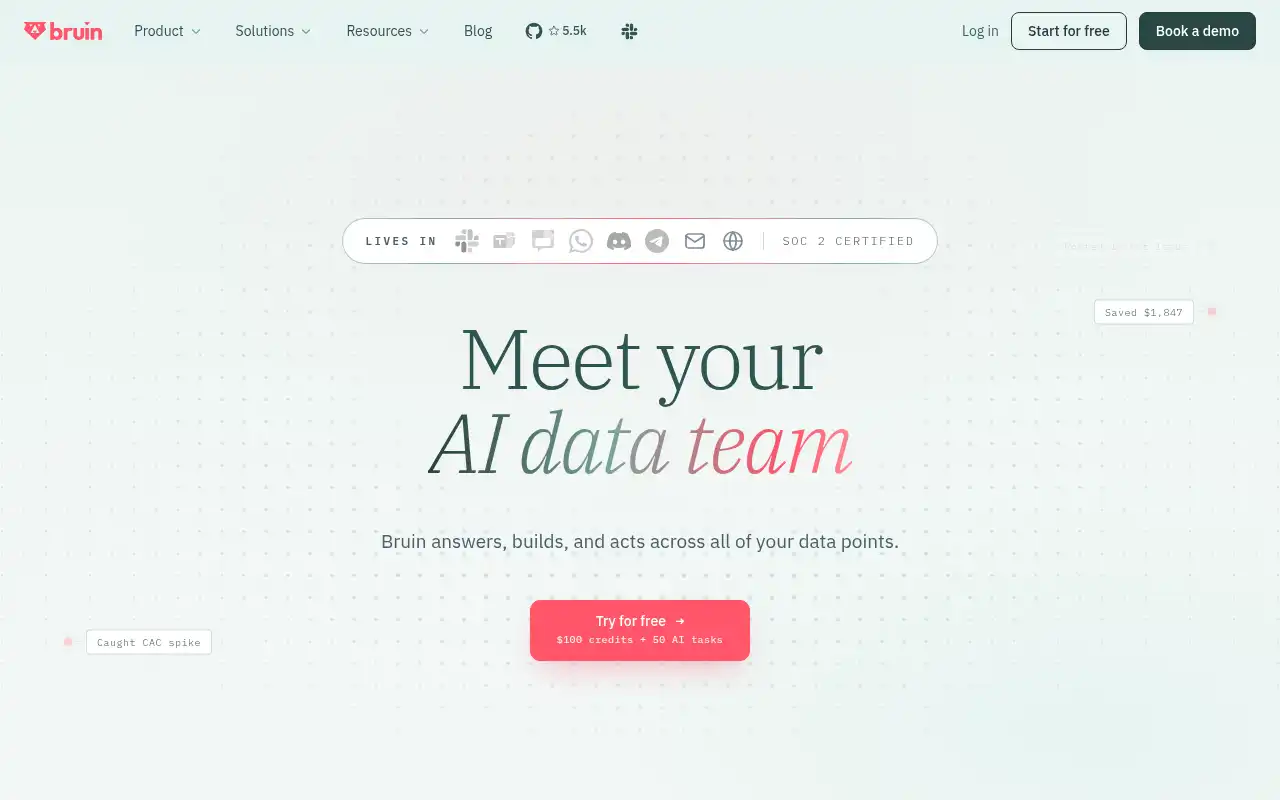
Bruin is a unified data pipeline platform that combines orchestration, ingestion, transformation, quality checks, and column-level lineage in a single tool. It uses a definition format based on YAML, SQL, and Python that AI agents can read and write, making it a natural fit for AI-assisted development workflows.
- Features: Unified platform covering ingestion, transformation, and quality in one tool, column-level lineage tracking, support for SQL, Python, and R pipeline definitions, built-in AI data analyst (chat with your data in Slack/Teams), MCP server for IDE integration (Cursor, Claude Code, Codex), Ingestr connectors for 50+ data sources, and scheduled cloud execution.
- Why You Should Use It: If you're tired of stitching together separate tools for ingestion, transformation, and orchestration, Bruin bundles everything into one platform. The AI analyst feature lets non-technical team members query data through Slack or Teams. The MCP server integration means you can build and manage pipelines directly from your IDE with AI assistance.
- Why Not: Bruin is younger and has a smaller community than established tools like Airflow or Dagster. Cloud pricing isn't publicly listed, making it hard to budget. The platform is more opinionated about how pipelines should be structured, which can feel restrictive if you need full flexibility.
- Pricing: The open-source CLI is free (MIT licensed). Bruin Cloud offers a free tier with $100 in credits and 50 AI tasks. Paid cloud pricing requires contacting sales. Self-hosting the CLI and running pipelines on your own infrastructure is completely free.
Conclusion
| Tool | Best For | Ease of Setup | Focus | Cloud Pricing |
|---|---|---|---|---|
| Mage AI | Notebook-style pipeline editing | Easy | Visual ETL/ELT | Mage Pro from $100/mo + usage |
| Apache Airflow | Maximum ecosystem and community | Hard | Programmatic DAGs | Astronomer from ~$250/mo |
| Dagster | Asset-centric data teams | Moderate | Data assets and lineage | Dagster+ from $10/mo + credits |
| Prefect | Python-first developer experience | Easy | Dynamic Python workflows | Prefect Cloud free to $400/mo |
| Kestra | Non-developer-friendly orchestration | Easy | Declarative YAML workflows | Kestra Cloud contact sales |
| Bruin | Unified pipeline platform with AI | Moderate | Ingestion + transformation + quality | Bruin Cloud contact sales |
Each tool fills a different gap: Airflow for maximum ecosystem reach and industry-standard orchestration, Dagster for asset-centric analytics engineering, Prefect for the cleanest Python developer experience, Kestra for accessible YAML-based workflows, and Bruin for a unified platform with built-in AI.
Mage AI remains a great choice for teams that want a visual, notebook-style pipeline editor with fast onboarding and built-in AI features. But if your needs lean more toward complex production orchestration, asset tracking, or non-code workflows, one of these alternatives might be a better fit.
If you want to self-host Mage AI, check out our guide on self-hosting Mage AI the easy way.